AI for the real economy.
You don't need more AI tools.
You need to know where AI actually pays. We're operators who find the few places AI will move your numbers, build them with your team, and set you up to keep evolving.
Your team is already using AI. Their instinct is right.
What's missing is the system that makes it compound instead of scatter. From data and process, to people, governance, and GTM motion.
What we see
AI use grows bottom-up in every company now. Different tools on every desk, minimal shared standards, results that vary person to person. The energy is real. The system around it isn't there yet.
What we build
We bring the framework that puts the best tool, or suite of tools, in front of each job, and the training so your people know how to get strong, consistent results from it. Multiple models checking each other beats betting everything on one.
No lock-in to one vendor's built-in AI that quietly pushes everyone back to the apps they already use at home.
of company AI projects return nothing measurable.
What went wrong
MIT studied 300 company AI projects in 2025. They didn't fail on the technology. They failed on implementation, and because no one tied them to a business outcome.
What we do instead
We start from the number.
We find the handful of areas where a project will move something real, build those first, prove it, and grow from there. We never bring AI in for its own sake.
The best tool today is obsolete by next quarter.
What we see
New models leapfrog each other constantly. Most companies get stuck either testing forever or locked into one mediocre tool nobody likes or uses.
What we build
We build plug-and-play governance, so you can pull one model out and drop a better one in without re-engineering your business. It's never about the one right tool. The best results come from a suite of tools whose strengths cover each other's gaps.
You stay on the best available technology, on your terms.
Who we are
Operators who build.
We're not a management consultancy, and we're not an AI shop. We do the uncommon thing in between: building the working systems, and only where they move a number.
Meet the teamHow we work
Pinpoint. Build. Train. Improve.
Pinpoint.
We learn how your business actually runs and pick the handful of projects that will move a real number.
Build.
We design and build working systems with your team. Including real tools your people will use, not recommendations.
Train.
Your people learn to own and run what is built, and to work with AI confidently on their own. The capability stays in-house and doesn't leave when we do.
Improve.
We keep your system current as the technology moves. And we help you find the next win. Stay with us for as long as it's helpful.
Most consultants hand over a deck and disappear. We hand over a working system your team can run, and we stay as long, or as short, as is useful to you.
Pinpoint.
We learn how your business actually runs and pick the handful of projects that will move a real number.
Build.
We design and build working systems with your team. Including real tools your people will use, not recommendations.
Train.
Your people learn to own and run what is built, and to work with AI confidently on their own. The capability stays in-house and doesn't leave when we do.
Improve.
We keep your system current as the technology moves. And we help you find the next win. Stay with us for as long as it's helpful.
Most consultants hand over a deck and disappear. We hand over a working system your team can run, and stay only as long as it's useful.
Where it pays
Where it pays.
Finance teams that stop closing the books by hand. Support teams that stop answering the same question twice. Sales teams that stop guessing. Decisions that stop stalling under the weight of new data.
A few patterns open most of our engagements, but every build is bespoke.
See the patterns →Why now
The window is roughly 18 months.
Companies getting this right are compounding an advantage that gets harder to catch the longer you wait. Doing nothing isn't standing still. It's falling behind while a competitor, or a faster newcomer, moves.
Weighing other options? Here's our honest comparison →
The first step is small on purpose.
One working session. A shortlist of what we'd build first.
A focused working session with our senior team. Not a pitch, and not a maturity audit. We dig into how your business actually runs and where a focused project would move a real number.
You walk away with:
- The two or three projects we'd build first
- What each one will move, and how we'd measure it
- What it realistically takes to build
- Yours to keep and act on, with us or without us
Not a report that sits in a drawer. A plan you could start building Monday.
From our Insight
What we're writing.
AI Adoption
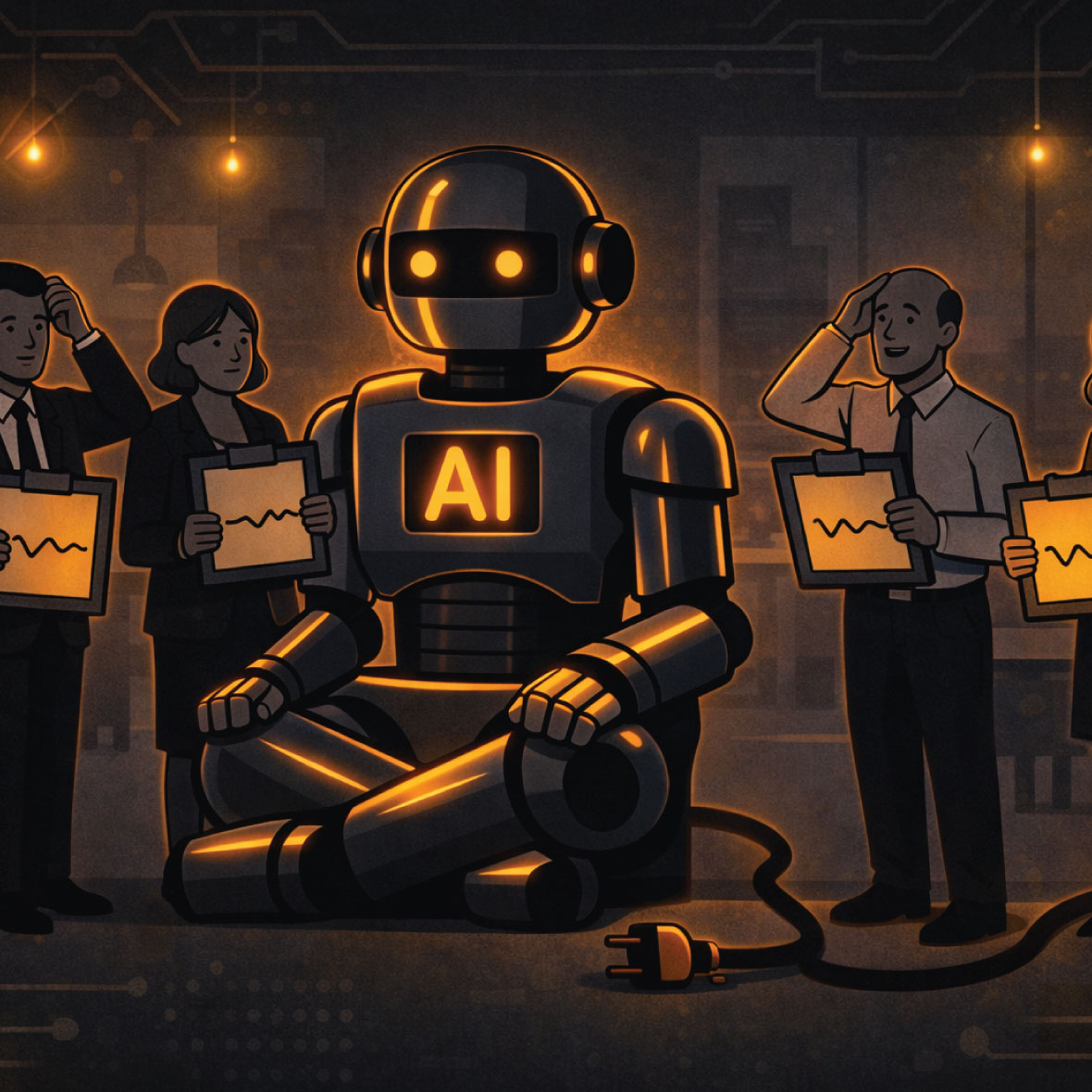
Why 95% of Companies See No ROI From AI
Most companies report zero ROI from GenAI. The problem isn't the technology — it's the operating model. Here's what revenue leaders need to change.
Read

Revenue Engine
RevOps Retention Playbook: Building the System Behind Sustainable Growth
Learn how to operationalize customer retention and expansion inside RevOps—from data infrastructure and KPIs to automation, playbooks, and advocacy loops.
Read

Revenue Engine
Rethinking RevOps: How Retention Became the New Growth Engine
Discover why modern RevOps teams are flipping the funnel to start with retention. Learn how customer expansion, advocacy, and post-sale engagement drive sustainable B2B growth.
Read
Ready when you are
Got a specific problem, or just a feeling you should be doing something about AI? Tell us about your business and we'll show you where to start.
One working session with our senior team. A shortlist of what we'd build first. No obligation, no sales sequence after.
We'll reply within one business day. No sales sequence, no spam.